# Pit Officer 0.1.0: pre-trade risk checks outside your trading bot
Pit Officer 0.1.0, the first beta, is a self-hosted service where the OpenPit engine checks every order before Officer sends it to Alpaca, whether it came from the web panel, trading software over REST or an AI agent over MCP. A rejected order sends nothing, and an agent cannot loosen the limits it trades under.
Canonical:
Author: Anna Palchukovsky
Description: A limit kept in your bot or an AI agent's prompt can fail when they do. Pit Officer 0.1.0 checks every order in a separate service before it reaches Alpaca.
Published: 2026-10-27T22:55:39+02:00
Updated: 2026-10-27T22:55:39+02:00
Tags: pit-officer, risk-controls, kill-switch, trading-bots
Your bot caps every order at 100 shares, and the cap lives in the bot: a bug
sends 500 anyway, and an AI agent given the cap in its prompt can be talked
into 10,000.
:::stat
**1.9 million USD**
10,000 shares of AAPL at 190 USD, where the cap allowed 19,000 USD. The
figures are illustrative.
:::
:::timeline
1. **You put the rule in the prompt.** "Never more than 100 shares."
2. **The agent is talked round.** It decides to buy 10,000 shares of AAPL.
3. **It sends the order to the broker.** Nothing between the agent and the
broker knows the rule.
4. **The order goes out.** 1.9 million USD, a hundred times the cap.
:::
Pit Officer 0.1.0, the first beta, moves that decision out: a separate service
on your own machine where the OpenPit engine checks every order before Officer
sends it to your broker. An order over the cap comes back rejected, and nothing
is sent.
:::cards
- **The decision leaves the bot.** Orders reach the broker through Officer, and
the OpenPit engine checks each one before it is sent. A rejected order is
never sent.
- **Four kinds of limit at this release:** order rate, order size by quantity
or notional, Spot Funds P&L bounds, and a block on an account or an account
group.
- **An agent gets only the tools you enable.** Every MCP tool that changes
state ships disabled, and Officer refuses any MCP call that would loosen
risk state - lift a block, raise a cap, grant trading access - whatever the
agent was told.
- **The limits bind only if the bot has no other road to the broker.** Officer
holds the Alpaca keys; the bot holds an Officer token.
- **0.1.0 is a beta:** one connection type (Alpaca), orders sent to paper
accounts, and no database migration between versions.
:::
## What does Pit Officer 0.1.0 do?
**It sits between whatever sends your orders and your Alpaca account, and lets
an order through only after the OpenPit engine has accepted it.**
Officer runs on your own computer from one Docker command, which publishes it
on that computer's loopback address. It has three ways in, each with its
own credential when you choose token access in the first-run setup:
:::cards
- **You, in the web panel.** A panel password, then a session.
- **Trading software, over REST.** An API token.
- **An AI agent, over MCP.** An agent token. It works on the agent's own
surface only, so an agent cannot reach the REST routes its MCP tools do not
expose.
:::
The checks are the OpenPit engine's own policies; Officer 0.1.0 is built on
OpenPit 0.10.0
([`go.mod` at v0.1.0](https://github.com/openpitkit/officer/blob/v0.1.0/go.mod)).
:::more[Terms this post uses]
A **pre-trade check** is a decision, made before an order leaves for the
venue, on whether it may go out at all. A **trading connection** is Officer's
link to one broker account: the provider, the mode (only `paper` at this
release), and the credentials, which Officer accepts on write and never returns
([API notes, Trading](https://github.com/openpitkit/officer/blob/v0.1.0/docs/api.md#trading)).
:::
:::more[The address, the three surfaces and their credentials]
The Docker command publishes Officer on the loopback address
`http://127.0.0.1:8787`, so it answers this computer and not the network; on
Linux, Docker Engine older than 28.0.0, or older than 28.3.3 with firewalld,
can still let other machines on the local network reach it
([README](https://github.com/openpitkit/officer/blob/v0.1.0/README.md),
[quickstart](https://github.com/openpitkit/officer/blob/v0.1.0/docs/quickstart.md#install-and-start-docker)).
The same address serves all three surfaces
([quickstart](https://github.com/openpitkit/officer/blob/v0.1.0/docs/quickstart.md#open-the-panel),
[API notes, Mount points](https://github.com/openpitkit/officer/blob/v0.1.0/docs/api.md#mount-points)):
- **Web panel** at `/`: the panel password, then a session cookie.
- **REST** at `/api/v1`, with its reference at `/docs`: the API token,
`Authorization: Bearer pit_api_...`.
- **MCP over HTTP** at `/mcp`: the agent token,
`Authorization: Bearer pit_mcp_...`.
The agent token sent to `/api/v1` is refused with `403 wrong_token`. The binary
also runs as a local stdio MCP server, `pit-officer mcp`, for MCP clients that
launch their servers themselves
([configuration reference](https://github.com/openpitkit/officer/blob/v0.1.0/docs/configuration.md#subcommands)).
:::
## Where does a rejected order stop?
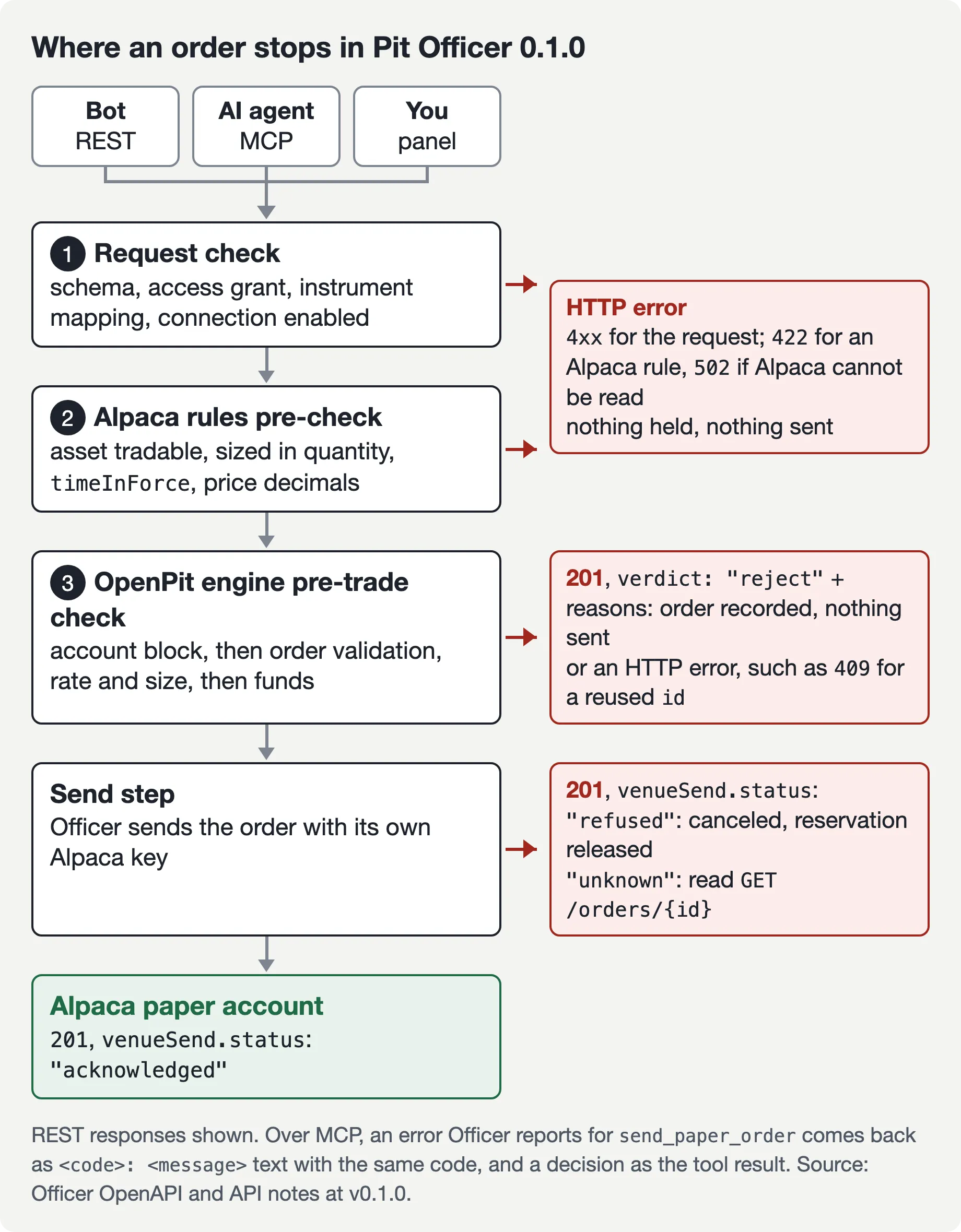
**At one of three checks before Alpaca, or at the send itself; from any
caller, only an order the engine accepts reaches the send.**
```d2 title="Where an order stops: three checks, then the send"
grid-rows: 6
grid-columns: 2
horizontal-gap: 90
vertical-gap: 50
callers: "Bot, AI agent\nor panel"
gap1: "" {style.opacity: 0}
request: "1. Request\ncheck"
gap2: "" {style.opacity: 0}
rules: "2. Alpaca's\nrules"
error: "Error:\nnothing sent"
engine: "3. OpenPit\nengine"
rejected: "Rejected:\nrecorded,\nnothing sent"
send: "Officer tries\nto send it"
notsent: "Refused: canceled,\nhold released.\nUnknown: read it\nbefore replacing it"
alpaca: "Alpaca\nacknowledged"
gap3: "" {style.opacity: 0}
callers -> request
request -> rules
rules -> engine
engine -> send
send -> alpaca
request -> error: fails
rules -> error: fails
engine -> error
engine -> rejected: "risk\nreject"
send -> notsent
```
A rejection at any of the three checks sends nothing to Alpaca. At the send,
Officer reports the order refused, which is final, or unknown: the order may
exist at Alpaca, or a refusal is not settled yet, so read it by its ID before
you send anything that replaces it. A blind resend can create a second order, which is its own subject:
[duplicate orders after a timeout](/blog/duplicate-orders-after-timeout/).
:::more[What each check stops, and what the REST call answers]
The REST call that sends an order, `POST /api/v1/orders/send-paper`, walks the
gates in this order
([OpenAPI at v0.1.0](https://github.com/openpitkit/officer/blob/v0.1.0/httpapi/openapi.yaml),
`sendPaperOrder` and `VenueSend`):
- **Request.** Stops the order when the body breaks the schema, the account
has no grant on the connection, the instrument is not mapped, or the
connection is disabled. You get an HTTP error; no order is held; nothing
reaches Alpaca.
- **Alpaca rules.** Stops it, for example, when the asset is inactive or not
tradable, the order is not sized in quantity, `timeInForce` is missing or
not allowed, a fractional equity order is not `day`, or an equity limit
price has more than 2 decimal places (4 below 1 USD). You get `422` with the
venue's reason, or `502` if Alpaca cannot be read; no order is held; nothing
reaches Alpaca.
- **Engine.** Stops it when a policy rejects it or the account is blocked. You
get `201` with `verdict: "reject"` and `reasons`, and no `venueSend`;
nothing reaches Alpaca.
- **Send.** Alpaca refuses it, Officer provably did not hand it over, or the
outcome cannot be established. You get `201` with `venueSend.status`
`refused` or `unknown`; at Alpaca the order was refused or never received,
or its fate is unknown.
The Alpaca rules gate reads the venue's own asset data: US equities and crypto
only, `timeInForce` one of `day`, `gtc`, `opg`, `cls`, `ioc`, `fok`, and for
crypto only `gtc` or `ioc`
([`alpaca.go` at v0.1.0](https://github.com/openpitkit/officer/blob/v0.1.0/internal/trading/alpaca.go)).
Catching these before the engine reserves anything means an order Alpaca would
refuse anyway does not hold buying power on the way.
:::
:::more[Refused, unknown, and why you send your own ID]
`refused` is definitive: either Alpaca refused the order or Officer provably
did not hand it over, and either way the order is recorded canceled with
nothing left open and its reservation released. `unknown` is not a refusal:
the call could not establish or record the outcome, so the order may exist at
Alpaca, or Alpaca refused it but the cancellation is not recorded yet or could
not be confirmed. Read `GET /api/v1/orders/{id}`, which the API notes name as
authoritative, before you send anything that replaces it; Officer's runtime
keeps reconciling every order that reached the send step
([API notes, Trading](https://github.com/openpitkit/officer/blob/v0.1.0/docs/api.md#trading)).
That lookup needs the order's `id`, and a caller that lost the whole response
never saw a server-generated one, so send your own `id` and record it before
the call, as the first order below does; a reused `id` is refused with `409`.
:::
## Which limits can you set in 0.1.0?
**Four kinds, kept by Officer; the engine applies each one you configure to a
new order that reaches its check.**
:::cards
- **Order rate.** At most so many order attempts in a time window, per account
exactly; broker-wide or per settlement asset up to twice as many can pass
at a window boundary. Rejected attempts that reach the rate check count too,
so a bot that retries fast keeps its window full. It caps a runaway loop.
- **Order size.** A cap on quantity per underlying asset or on notional per
settlement asset, broker-wide or per account. It stops a quantity bug or a
fat-fingered order.
- **Spot Funds P&L bounds.** A lower bound, an upper bound or both on an
account's realized P&L, globally, per account group or per account. When
the P&L is outside a bound you set, or its calculation has halted, the
engine rejects the account's new orders; a fill that gets it there blocks
the account.
- **Block.** An account or a group you block: the engine rejects every new
order from it before any policy runs.
:::
The block is the piece the
[crashed-bot article](/blog/trading-bot-crashed-open-position/#how-does-a-halt-survive-the-restart)
asked for: a halt that does not live in the bot's process. Officer stores it
in its own database, so a bot that crashes and restarts comes back to an
account still blocked until you unblock it. The block gates new orders only:
nothing in the 0.1.0 documentation says Officer cancels working orders or
closes positions when your bot dies, so the venue timers and the
second-process watchdog from that article still apply.
:::more[The four limits in the API]
- **Order rate** (`PUT /limits/rate`): passes at most `maxOrders` order
attempts per `windowMs` milliseconds; every attempt that reaches the rate
check counts, rejected ones included. Broker-wide and per settlement asset
it counts in an approximate fixed window that can let up to twice
`maxOrders` through at a window boundary; per account, and per account and
settlement asset, in a precise sliding one
([OpenPit rate-limit policy at v0.10.0](https://github.com/openpitkit/pit/blob/v0.10.0/crates/openpit/src/pretrade/policies/rate_limit.rs)).
A request refused before the engine check, at the request or Alpaca rules
gate, is not counted.
- **Order size** (`PUT /limits/order-size`): `maxQuantity` keyed on the
underlying asset, `maxNotional` keyed on the settlement asset, broker-wide or
per account. An order over the quantity cap alone is rejected by
`OrderSizeLimitPolicy` with reason "order quantity exceeded", which Officer
reports as code `order_qty_exceeds_limit`
([OpenPit wiki, Policies, 2026-10-27](https://github.com/openpitkit/pit/wiki/Policies/7d213d39fc9f342d7d9fc9449081886ecc370c53),
[Officer reject codes at v0.1.0](https://github.com/openpitkit/officer/blob/v0.1.0/framework/domain/reject_codes.go)).
- **Spot Funds P&L bounds** (`PUT /limits/spot-funds-pnl-bounds`): a
`lowerBound`, an `upperBound` or both in one currency, globally, per account group or
per account, on the account's realized P&L, which the engine builds from
reconciled fills and fees. Its policy name in the API is
`spot_funds_pnl_bounds_kill_switch`
([OpenPit wiki, Spot Funds, 2026-10-27](https://github.com/openpitkit/pit/wiki/Spot-Funds/7d213d39fc9f342d7d9fc9449081886ecc370c53),
[Account Blocking, 2026-10-27](https://github.com/openpitkit/pit/wiki/Account-Blocking/7d213d39fc9f342d7d9fc9449081886ecc370c53)).
- **Block** (`POST /accounts/{code}/block` with a `reason`, and the same on a
group): a blocked account, or any member of a blocked group, is rejected
before any policy runs. The account's `blocked` field reports whether the
account or its group is blocked; an unblocked account can still fail on a
missing grant, funds or a limit.
Officer stores the block with the account on the `pit-officer-data` volume
([schema at v0.1.0](https://github.com/openpitkit/officer/blob/v0.1.0/framework/store/schema/migrations/0001_init.sql)),
and clearing it is an explicit `unblock`.
:::
## How do you send a first order through Officer?
**Start it, finish the setup, describe what you trade, fund the account, set
one limit, and send one order over REST.**
1. **Start Officer** with the README's Docker command, pinned to the 0.1.0
image: the README's own tag follows the newest stable release.
2. **Finish the first-run setup** in the panel. Choose multi-account mode: on
a fresh Officer, single-account mode acts only on one account it creates
and refuses to create another. Choose token access to get an API token for
your bot.
3. **Describe what you trade.** A fresh Officer has nothing set up. Create the
assets AAPL and USD first, because Officer will not map an instrument whose
asset it does not know; then an account named desk in USD, an Alpaca
connection in paper mode with your paper keys, an enabled AAPL mapping, and
access for desk to the connection.
4. **Fund the account in Officer.** The engine checks a buy against the USD
balance Officer records, not Alpaca's, and rejects an unfunded one: record
no more than the venue cash you are willing to deploy.
5. **Set the limit:** at most 100 AAPL per order on desk.
6. **Send the order:** buy 10 AAPL at a limit of 190 USD, under an ID you
recorded before the call, so you can look the order up even if the
response never arrives.
7. **Read the decision.** An order the engine accepts and Alpaca acknowledges
comes back with both answers. The same order for 500 shares is a
successful call too, rejected, with nothing sent to Alpaca; the panel shows
the recorded rejection and its reason.
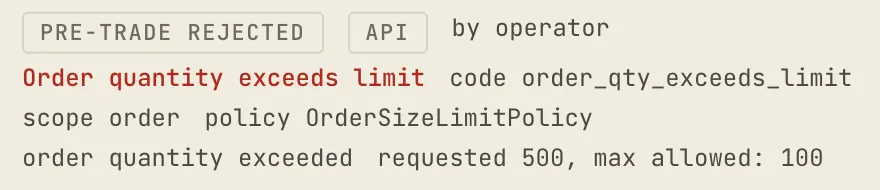
Branch on the verdict, not on the HTTP status: a risk reject is a decision,
not an error. To test a limit without sending anything, Officer's order check
takes the same order economics and answers whether they would pass and, if
not, why; it records and reserves nothing.
:::more[The commands, request bodies and responses, step by step]
1. **Start Officer** with the
[README](https://github.com/openpitkit/officer/blob/v0.1.0/README.md#run)
command, pinned to the release: the README's `latest` tag follows the newest
stable release, `0.1.0` stays on this one.
```sh
docker run -d --name pit-officer --restart unless-stopped -p 127.0.0.1:8787:8787 -v pit-officer-data:/data ghcr.io/openpitkit/officer:0.1.0
```
`docker ps --filter name=pit-officer` shows `(healthy)` when the panel
answers; that says nothing about whether anything is set up yet.
2. **Finish the first-run setup** at `http://127.0.0.1:8787/setup`: welcome,
accounts, encryption, approval signing, access, connecting your AI agent,
done. Until it is finished, `/api/v1` and `/mcp` answer
`503 setup_required`. Single-account mode acts only on the account it
creates, `default`
([API notes, Single-account mode](https://github.com/openpitkit/officer/blob/v0.1.0/docs/api.md#single-account-mode)).
3. **Describe what you trade**: the assets `AAPL` and `USD`, the account
`desk` with currency `USD`, the Alpaca connection in `paper` mode, the
`AAPL` mapping and the access grant. Officer refuses an instrument mapping
whose asset it does not know, and never creates one itself
([quickstart, What comes next](https://github.com/openpitkit/officer/blob/v0.1.0/docs/quickstart.md#what-comes-next)).
4. **Fund the account.** An unfunded buy is rejected with `insufficient_funds`
([engine test at v0.1.0](https://github.com/openpitkit/officer/blob/v0.1.0/engine/mapping_test.go)).
The size and rate limits run first, and the funds check only for an order
that passes them
([OpenPit wiki, Policies, 2026-10-27](https://github.com/openpitkit/pit/wiki/Policies/7d213d39fc9f342d7d9fc9449081886ecc370c53)),
so the deposit is what lets the 10-share order through. Officer 0.1.0 does
not read the Alpaca balance: each buy is checked against the USD balance
this deposit seeds, not against Alpaca's. 100,000 USD covers the 1,900 USD
first order. Record it
with `POST /api/v1/accounts/desk/adjustments?missingAccount=reject`, in the
body shape the tag's integration test uses:
```json
{
"type": "deposit",
"asset": "USD",
"averageEntryPrice": "1",
"realizedPnl": "0",
"balance": {"mode": "absolute", "value": "100000"}
}
```
5. **Set the limit** with
`PUT /api/v1/limits/order-size?missingAccount=reject` and this body:
```json
{
"scope": "account_underlying_asset",
"account": "desk",
"asset": "AAPL",
"maxQuantity": "100",
"maxNotional": ""
}
```
6. **Send the order.** With one enabled paper connection available to `desk`,
`destination` needs only the Alpaca route; quantities and prices are exact
decimal strings, not floats. `price` makes it a limit order; without it the
order is a market order, which the funds check prices off a live mark quote
and rejects when Officer has none. The `id` is yours.
```sh
# Body shape as in TestTradingSendPaperEndToEnd at v0.1.0, which sends it
# over REST to a stub Alpaca.
curl -s http://127.0.0.1:8787/api/v1/orders/send-paper \
-H "Authorization: Bearer $PIT_API_TOKEN" \
-H "Content-Type: application/json" \
-d '{
"id": "desk-0001",
"account": "desk",
"baseAsset": "AAPL",
"quoteAsset": "USD",
"side": "buy",
"amountKind": "quantity",
"amountValue": "10",
"price": "190",
"destination": {"route": {"timeInForce": "day"}}
}'
```
7. **Read the decision.** When the engine accepts the order and Alpaca
acknowledges it, the response carries both answers (angle brackets mark
values your call returns):
```json
{
"id": "desk-0001",
"verdict": "accept",
"signedApproval": "",
"keyId": "",
"venueSend": {
"status": "acknowledged",
"venueOrder": {
"connection": "",
"venueAccount": "",
"route": {"timeInForce": "day"},
"clientOrderId": "",
"venueOrderId": "",
"sendAttempted": true,
"createdAt": "